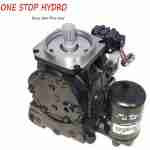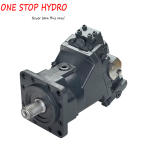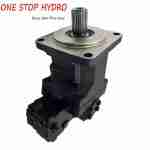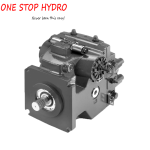
Precautions for axial piston pump
① Motor or internal combustion engine can be used as prime mover for axial piston pump.
Axial piston pump shaft extension has flat key and spline, usually pump can use flat key and spline, and motor best use spline. The additional axial force and radial force produced by the transmission device (coupling, gear, V-belt, etc.) of the pump on the transmission shaft of the piston pump should be reduced as far as possible, while some pumps, such as A4VSO and a4fo series helical pumps, have no such requirement. When the helical piston pump uses gears to transmit power, its main shaft can bear certain radial force, and its allowable value is related to the diameter of the pinion; the axial load is related to the diameter of the shaft extension. When V-belt is used to transmit power, the minimum diameter of the small pulley on the pump drive shaft is 5 times of the shaft extension diameter, which can obtain the best service life of the bearing. But some pumps require that the transmission device can not produce additional axial force and radial force on the transmission shaft of the pump.
② Oil selection and filtration work, oil varieties and brands should be strictly in accordance with the provisions of the pump product instructions for selection, in order to extend the service life of the pump. Usually, the working medium used is mineral oil, so the sealing ring made of NBR is used for pump and motor. If the fire-resistant hydraulic fluid is used in the high temperature situation, some fire-resistant hydraulic fluid can not use nitrile rubber seal ring, such as phosphate ester should use fluororubber seal. For general pumps, the service life and performance of fire-resistant hydraulic fluid will be affected. Therefore, the technical parameters of mineral oil should be changed appropriately. For example, when water ethanol is used as the working medium, the rated pressure is about 70% of the original, and the nominal speed is generally 1000-1500r / min, because cavitation is easy to occur when it is more than 1500r / min, and some are also useful to 1800r / min. The oil should be kept clean. Generally, the filter with 100 μ m filtration accuracy is selected for oil absorption, and the filter with 10 ~ 20 μ m filtration accuracy is selected for oil return or oil supply.
The use temperature range of mineral oil is generally – 20 ~ 80 ℃, and the most suitable working temperature is 20 ~ 50 ℃.
③ In order to prevent cavitation, the pressure at the inlet should be increased. If conditions permit, it is better to have a positive pressure of about 0.02MPa.
④ Installation, operation and maintenance
a. Installation
1. Because the transmission shaft of straight shaft piston pump and motor is equipped with cylinder block, it is very sensitive to the radial force on the shaft extension, and affects the bearing life. Therefore, it is generally not allowed to directly install the pulley, gear and sprocket at the shaft extension. If it is necessary to install it, the transition bracket should also be added. There are coaxiality requirements for the shaft extension connection of prime mover and pump. Generally, it is recommended that the axis offset should not exceed 0.05mm and the angle deviation should not exceed 0.5 °. Flexible coupling is required.
II. When the pump is installed horizontally, the pressure port shall be installed laterally or upward; the suction port shall be installed laterally or downward. If the pump’s working speed is low, the suction port of the pump shall be installed upward, so that it is easy to absorb oil when starting. The drain port should always be installed upward.
III. the support (seat) of the pump should be firm and rigid. It is recommended to set anti vibration pad to reduce vibration and noise. The commonly used mounting parts such as bell type mounting support (flange), coupling and mounting bracket can be purchased directly from the pump manufacturer.
The piping diameter of the suction, pressure and discharge ports of the pump shall be equal to or greater than the specified value of the product. In order to avoid improper assembly of steel pipe and forced displacement of pump, resulting in radial force and noise transmission on shaft extension, a section of hose should be connected. In order to avoid air suction, the oil suction pipe should be inserted below the liquid level. It is recommended that the depth of the oil suction pipe should be (3-4) d from the lowest liquid level (D is the pipe diameter); the oil pipe opening should be more than 150 mm from the bottom of the oil tank. The pipe end is cut with 45 ° bevel. For the self-priming pump allowed to be installed on the oil tank, the distance between the pump axis and the liquid level is not more than 500mm. Even if the pump installation position is lower than the liquid level of the oil tank, the pipeline should be as short as possible, and the right angle elbow should not be connected as far as possible. It is recommended to use the oil suction filter on the box side, because it has a self sealing valve, which has no influence on the replacement of filter element and the maintenance of pump. The length of the oil drain pipe should be as short as possible. If it exceeds 1-2m, the diameter should be increased to ensure that the pressure in the shell does not exceed 0.03mpa, so as to avoid the damage of the shaft head seal. The oil drain pipe shall be directly returned to the oil tank separately, away from the oil suction pipe and inserted below the liquid level. It shall not be used with system oil return pipe. For the pump or motor with several oil drain ports, the highest position of the interface piping should be selected, as shown in Figure Q. the height of the piping part should be higher than the height of the highest part of the pump body. When the pump is used reversely as a motor, the oil return pipe should be far away from the oil suction pipe, inserted below the liquid level, and the pipe end should be cut 45. The inclined port faces the tank wall.
b. Before starting, operating and maintaining the plunger pump, check whether the pipeline connection is correct, whether the oil tank is filled with oil, and whether the relevant screws are tightened. After the above problems are checked correctly, for the pump requiring oil injection, according to the product manual, before the first use or start-up, fill oil into the specified oil port and open the vent plug: horizontally install (pump or motor axis horizontal orientation), fill oil into the inner cavity of the shell from the oil injection port at the highest part of the shell (if there is no oil injection port, the oil drain port can be used) until it overflows Slowly rotate the transmission shaft to exhaust the air; for vertical mounted pumps and motors, whether installed inside or outside the oil tank, they should be placed in a horizontal position and filled with oil in a horizontal way before installing the pump or motor. After oil filling, tighten the vent plug.
Then the following inspection work is carried out: slowly pull the coupling by hand to check whether the force is uniform; whether the system is in the unloading condition; whether the pipeline joint leaks air; click the start button of the pump to check whether the rotation direction meets the requirements, etc.
When starting, it is not allowed to start rapidly at full speed, but in the unloading state of the system, the prime mover can be started and closed several times before continuous no-load operation. The purpose is to remove the air in the pipe as clean as possible. After the low speed warm-up operation or no-load running for a period of time (1 ~ 2min), check that the system functions normally under no-load condition, and then gradually increase the load. During the loading process, there should be no abnormal vibration, noise, leakage, etc., otherwise stop the machine immediately for inspection and troubleshooting.
After normal operation, the pump should prevent narrow suction and the motor should prevent overspeed. Pay attention to the oil level, temperature and cleanliness of the oil tank, and change the oil and filter regularly.