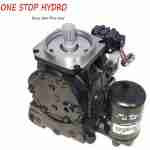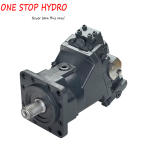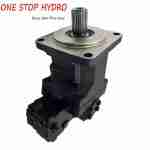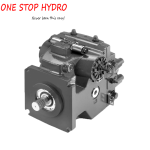
Typical structure of radial piston pump with valve distribution
(1) Radial piston pump with valve distribution
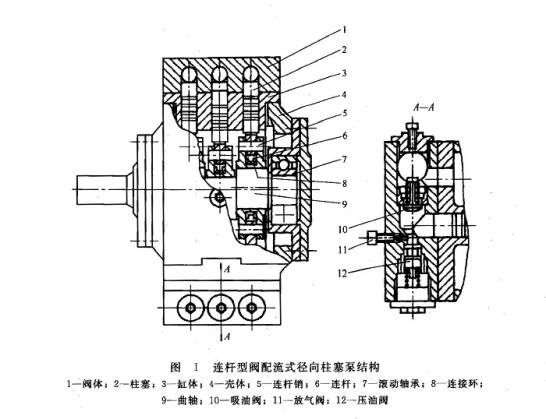
① Connecting rod valve port type radial piston pump in the connecting rod valve port type radial piston pump as shown in figure I, the crankshaft 9 is supported on the shell 4 through a pair of rolling bearings 7, the plunger 2 is hinged on the connecting rod 6 with connecting rod pin 5, the upper and lower connecting rods are supported on the crankshaft with two semicircle connecting rings 8 (sliding friction between connecting rod and crankshaft), and the two connecting rings are connected with screws. The shell 4 is fixed with a cylinder body 3 and a valve body 1, and each piston cylinder on the valve body is respectively equipped with a suction valve 10 and a pressure valve 12. When the crankshaft rotates, the oil is sucked in from the oil suction valve port, enters the plunger cylinder, and then is pressed out through the oil pressure valve. There are six plungers on the three cranks of the crankshaft, which are divided into two groups. Its oil outlet can be combined to be used as a large flow pump, or the two groups can be used separately as two pumps.
② The straight rod valve distribution type radial piston pump is shown in Fig. J. the straight rod valve distribution type radial piston pump is mainly composed of a shell 1, an eccentric wheel (integrated with the main shaft) 2, a flat oil suction valve 3, a spherical oil pressure valve 4, a plunger 6 and a valve body 7. Spring 8 keeps the plunger against the outer ring of the ball bearing outside the eccentric. The eccentric wheel and the main shaft rotate for one circle, the plunger completes a reciprocating stroke, and sucks and presses oil once respectively. When the pump works, the oil from the oil tank flows out from the center hole of the main shaft through the four radial holes of the main shaft under the action of centrifugal force, so that the pressure in front of the oil suction valve is improved, so that the suction performance, cavitation performance and volumetric efficiency of the valve are improved. There is a rolling bearing on the outer circle of the eccentric wheel, so that there is rolling friction between the plunger and the eccentric wheel, thus improving the mechanical performance of the pump Mechanical efficiency. There are 3, 5 and 7 kinds of plunger in this kind of pump, and the working pressure is up to 63Mpa.
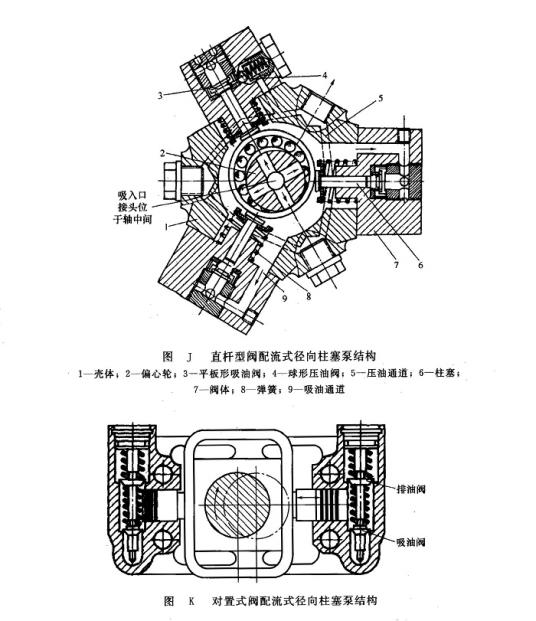
③ Figure K shows the structure of the opposed valve radial piston pump. In radial piston pump, two cylinder and four cylinder pump often adopt this kind of arrangement. Figure K shows a four cylinder pump. Each group of four plungers is connected by a rectangular frame. The two eccentric discs with a difference of 180 ° on the pump shaft move back and forth through sliding block drag action. Each cylinder is equipped with independent oil suction and pressure valves, and they are connected to the common oil suction and discharge cavities. Limited by the stiffness of the frame and the allowable specific pressure of the sliding surface, the pressure and speed of the pump are not high, but it can use the way to adjust the suction oil volume, and is not sensitive to the change of medium viscosity and pollution.