Working principle and key points of inclined axial piston pump
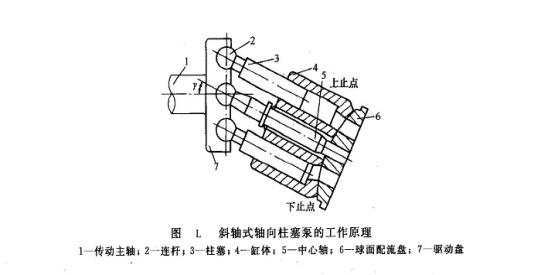
As shown in Fig. L, the oblique axial piston pump is composed of a transmission spindle 1, a connecting rod 2, a plunger 3, a cylinder block 4, a central shaft 5, a spherical port plate 6, a shell and a back cover (not shown in the figure), etc. The cylinder block and the axis of the transmission main shaft form an inclined angle γ. The drive plate 7 at the end of the shaft is connected with each plunger in the cylinder block by universal hinges and connecting rods. When the prime mover drives the main shaft of the pump to rotate, the connecting rod and plunger pair alternately “move” the cylinder block to slide and rotate on the port plate with waist window. Because there is an included angle between the spindle and the cylinder axis, when the plunger moves from the bottom dead center to the top dead center, an oil suction stroke is obtained, and the oil is sucked into the cylinder through the oil suction port and the waist window of the valve plate. When the plunger moves from the top dead center to the bottom dead center, the oil pressure stroke will be generated, and the oil filled in the cylinder block hole will be discharged through the port plate and the oil outlet. From the direction of the drive shaft, if the pump rotates clockwise (right), the oil suction port is on the left side of the rear cover and the oil pressure port is on the right side of the rear cover. Still looking from the direction of the drive shaft, if the drive shaft rotates counterclockwise (left turn), the oil suction port is on the right side of the rear cover and the oil pressure port is on the left side of the rear cover.
On the working principle of inclined axial piston pump, we should pay attention to the following points.
① Variable problem. When the displacement of the pump is made into an inclined cylinder, the inclination angle of the piston can be changed, that is, the inclination angle of the steering wheel can be changed Two way variable displacement pump. However, because the inclination angle γ can reach ± 40 ° which is much larger than that of swash plate pump (the maximum is ± 20 °), it can obtain larger displacement than swash plate piston pump when other parameters of T are the same..
② There are three pairs of important friction pairs: cylinder and plunger, cylinder and port plate, connecting rod and plunger. The key parts of these friction pairs work in bad condition. Their friction and wear directly affect the volumetric efficiency, mechanical efficiency, working pressure and service life of the pump. For this reason, the cylinder plug hole and the spherical surface matched with the valve plate are often cast with copper alloy layer, and have strict dimensional accuracy and shape position accuracy requirements.
③ The drive spindle plays the role of transmitting torque. There are eight ball sockets on the drive disc, which are respectively connected with a piston pair of the connecting rod and the ball head of the central shaft. One of them is matched with the framework oil seal. Therefore, the shaft diameter matched with the bearing, the shaft diameter matched with the framework oil seal and the ball socket of the drive disc have higher dimensional accuracy and shape position accuracy requirements.
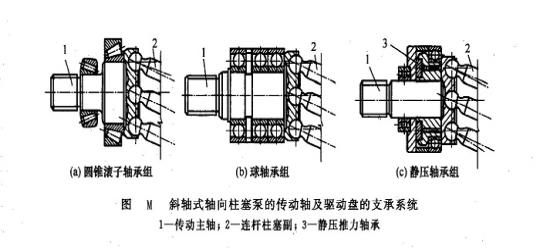
④ The hydraulic reaction force of each plunger of the inclined shaft pump is completely borne by the rotating pump drive shaft, so it is necessary to configure the centripetal thrust bearing system with high bearing capacity or adopt special bearings or even hydrostatic bearings (Fig. m).
⑤ Because the transmission spindle does not pass through the cylinder, the cylinder diameter of the inclined shaft pump can be smaller, and the overturning effect of the lateral force on the cylinder is also small, so the working condition of the port pair is better than that of the straight shaft pump, and the allowable speed is also higher.
⑥ The lateral force on the cylinder body of the inclined shaft pump is small, so the supporting system is slightly simpler than that of the straight shaft pump. At present, the popular structure is that the cylinder block is supported on a central pin with needle roller bearing or sliding bearing. If the spherical port pair is used, the radial support of the port plate on the cylinder block can be used.
⑦ Both ends of the connecting rod are ball ends, as shown in Figure n (a), one end is hinged in the ball socket of the drive plate of the transmission shaft with a pressing plate (sometimes the inner wall is covered with a friction reducing layer), and the other end is hinged in the steel column plug with a rolling process. The middle part of the connecting rod needs to be made into a cone to match the taper hole in the plunger to transfer the lateral force. A long hole is often machined in the head of the plunger and the center of the connecting rod as a lubricating oil passage. Some hinged swash plate pumps with large swing angle adopt the structure of “no connecting rod” [Fig. n (b)], in fact, the conical plunger takes into account the function of connecting rod. The head of the plunger extending into the cylinder is made with a spherical section, which is sheathed with 1-2 spherical elastic plunger rings to form a sliding sealing system, and the conical section of the rod is used to directly transfer force to the cylinder and move the cylinder body to rotate. The piston of variable displacement pump driven by double hinged constant velocity universal joint does not need to transfer tangential force. It is often made into the form of drum shaped spherical piston with thin rod body [Fig. n (c)]. It is also equipped with spherical piston ring. When the swing angle of cylinder is large, it can ensure the sealing without interference. Whether there is a connecting rod or not, the return capacity of the inclined shaft pump plunger is better than that of the straight shaft pump, so the self-priming performance of the inclined shaft pump is also better.